
If you’re researching commercial roofing, you’ve likely come across two top contenders for flat or low-slope roofs: TPO (Thermoplastic Polyolefin) and PVC (Polyvinyl Chloride).
At first glance, they look similar — both are single-ply membranes that can be heat-welded and come in white, reflective rolls. But there are key differences in composition, cost, chemical resistance, and performance that can make one better suited for your building than the other.
Here’s a detailed comparison to help you make an informed decision.
What Is TPO Roofing?
TPO (Thermoplastic Polyolefin) is a single-ply roofing membrane made from a blend of polypropylene and ethylene-propylene rubber, reinforced with polyester fabric. It was introduced in the 1990s as a more affordable, energy-efficient alternative to PVC.
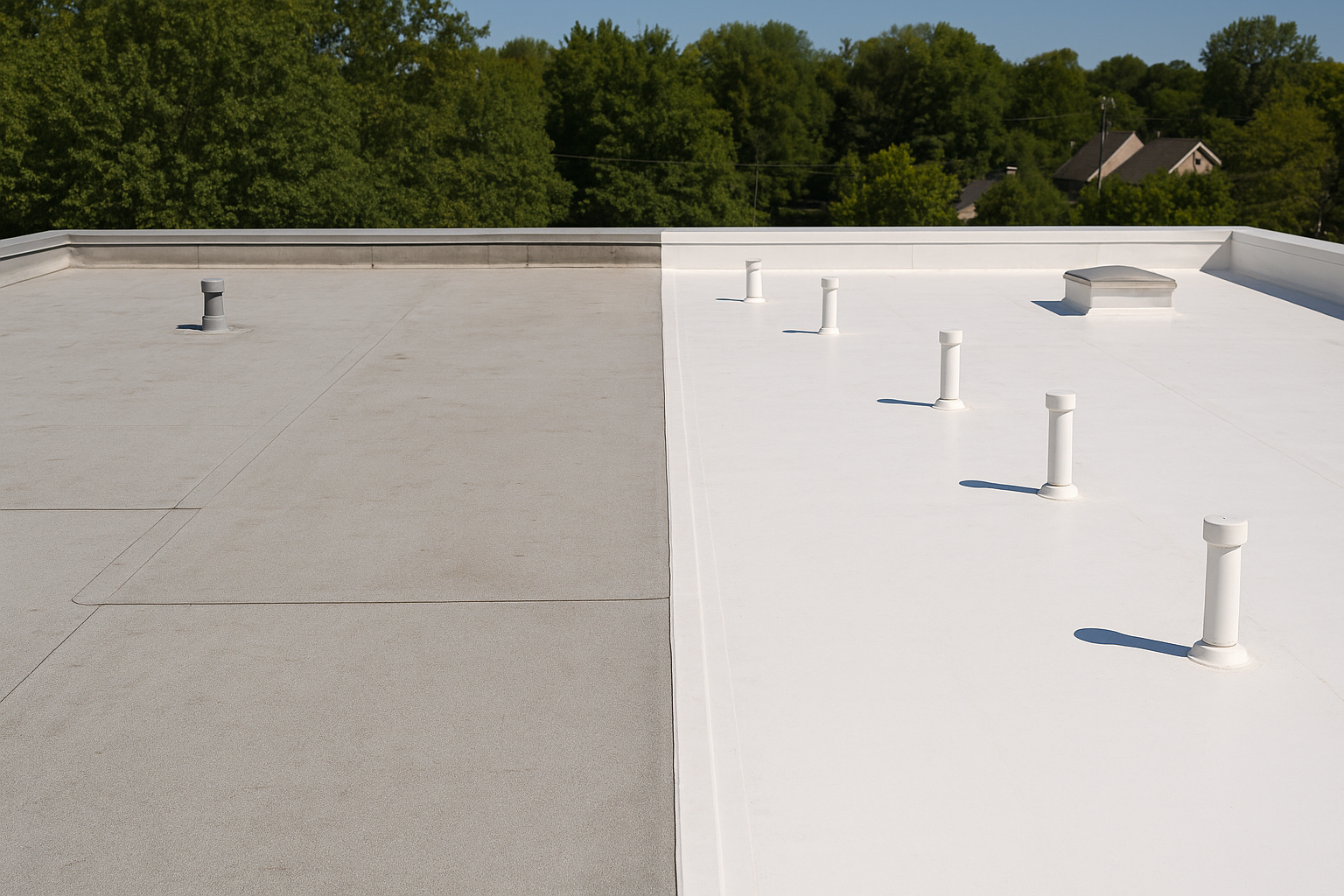
TPO membranes are typically white, tan, or gray — colors chosen for high reflectivity and energy savings. Seams are hot-air welded, creating a strong, watertight bond.
Lifespan: 20–30 years
Best for: Energy efficiency and cost-conscious projects
Common uses: Warehouses, office parks, retail centers, multifamily housing
What Is PVC Roofing?
PVC (Polyvinyl Chloride) roofing has been around since the 1960s and is made from polyvinyl chloride with plasticizers that add flexibility. Like TPO, it’s a single-ply membrane, installed in large rolls and heat-welded at the seams.
PVC is known for its chemical resistance and durability, which makes it ideal for restaurants, factories, and other facilities exposed to grease or harsh materials.
Lifespan: 25–35 years
Best for: Chemical resistance and long-term performance
Common uses: Restaurants, food plants, manufacturing, hospitals
Key Differences Between TPO and PVC Roofing
1. Material Composition
TPO: Made of thermoplastic polyolefin (a blend of rubber and plastic). Flexible, lightweight, and environmentally friendly.
PVC: Made of vinyl resin and plasticizers. More rigid, but very resistant to chemicals and oils.
Verdict: PVC is tougher in chemical-heavy environments, while TPO is more eco-friendly and affordable.
2. Seam Strength and Installation
Both systems use heat-welded seams, forming durable, watertight connections. However:
TPO seams tend to be slightly stronger because they form a molecular bond during welding.
PVC seams are time-tested, proven reliable for decades.
Verdict: Both perform exceptionally well, but TPO has a slight edge in seam strength due to its modern formulation.
3. Energy Efficiency
TPO: Designed for reflectivity. The white surface reflects UV rays, reducing cooling costs in hot weather.
PVC: Also reflective, though it can lose some reflectivity over time if exposed to certain chemicals or pollutants.
Verdict: TPO and PVC are both excellent for energy efficiency, but TPO may stay cooler longer in direct sunlight.
4. Chemical Resistance
TPO: Resistant to UV and ozone but not ideal for roofs with chemical exposure (like restaurant exhausts).
PVC: Outstanding chemical and grease resistance, making it the go-to for industrial or restaurant roofs.
Verdict: PVC wins for any building exposed to oils, grease, or harsh fumes.
5. Flexibility and Weather Resistance
TPO: Handles thermal expansion well, great for areas with wide temperature swings.
PVC: Also flexible, though older PVC roofs can become brittle as plasticizers age.
Verdict: TPO may be a better fit for regions with freeze-thaw cycles, like the Midwest.
6. Environmental Impact
TPO: 100% recyclable and contains no chlorine. Often seen as the more sustainable option.
PVC: Contains chlorine and plasticizers, which can release pollutants when produced or disposed of.
Verdict: TPO is the greener choice for eco-conscious projects.
7. Cost
Installed costs vary by region and roof size, but generally:
TPO installed: $5–$9 per sq. ft.
PVC installed: $6–$10 per sq. ft.
PVC’s higher price reflects its proven longevity and superior chemical resistance.
Pros and Cons at a Glance
| Feature | TPO (Thermoplastic Polyolefin) | PVC (Polyvinyl Chloride) |
|---|---|---|
| Lifespan | 20–30 years | 25–35 years |
| Energy Efficiency | Excellent (highly reflective) | Excellent (slightly less over time) |
| Seam Strength | Heat-welded, very strong | Heat-welded, proven over decades |
| Chemical Resistance | Moderate | Excellent (grease, oil, acids) |
| Flexibility | Great in temperature extremes | Good; may stiffen with age |
| Cost (installed) | $5–$9 per sq. ft. | $6–$10 per sq. ft. |
| Environmental Impact | Recyclable, chlorine-free | Contains chlorine and plasticizers |
| Best For | Energy savings, cost efficiency | Harsh environments, chemical exposure |
What about TPO vs EPDM? Find out the pros and cons of each here!
Which Is Better for Your Building?
Choose TPO if:
You want a cost-effective, energy-efficient system.
Your roof isn’t exposed to chemical or grease exhausts.
You value environmental sustainability.
Choose PVC if:
Your building houses a restaurant, factory, or lab.
You need maximum chemical resistance and long-term performance.
You don’t mind a higher upfront investment for added durability.
Ohio and Midwest Perspective
For Ohio and surrounding states, both materials perform well across all four seasons.
TPO handles freeze-thaw cycles, humidity, and UV exposure effectively — ideal for warehouses, offices, and retail properties.
PVC is excellent for manufacturing or food-related businesses where roof contaminants are common.
Because both are heat-welded systems, they hold up well against the rain, snow, and temperature swings typical of the Midwest.
Final Thoughts
TPO and PVC are both outstanding flat roofing systems — and both offer excellent energy efficiency and long-term protection.
TPO is generally more affordable and environmentally friendly.
PVC is more chemical-resistant and proven to last longer in demanding environments.
The right choice comes down to your building’s purpose, budget, and exposure conditions. A professional commercial roofing contractor can inspect your property and help you select the best system for your needs.
Need help deciding? Reach out to us today and schedule your free consultation with our experts.